
When Development Outpaces Planning: how the city’s lagging data drives overdevelopment
In September 2025, the City of San Diego released its 2025 Annual Report on Homes, intended to track progress toward state housing goals and provide residents and policymakers with transparent, data-driven insights. But what if the data is already outdated? Our review found that the city relies on information that lags at least a year behind current conditions, while density bonus programs such as Complete Communities and ADU Bonus accelerate development beyond neighborhood capacity. This prioritizes private profit over long-term community well-being. Read on to see how this plays out in Greater Golden Hill.
A Case Study in Overdevelopment
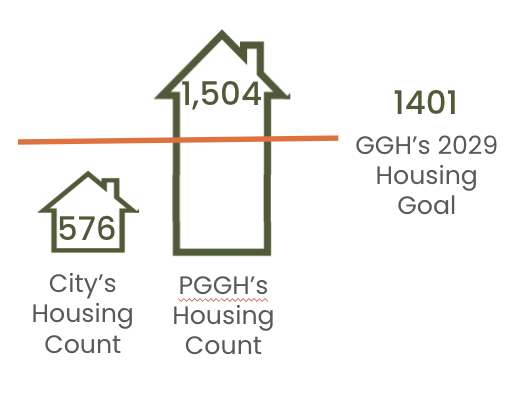
An analysis of the City’s Permitting Dashboard—the same database the city uses for its annual housing report—shows that GGH has 1,500 units either completed or underway.
This exceeds the 576 units reported by the City, and the 1,401 unit development goal for our community by a factor of three!
Mapping Density Development
The map below shows all housing units developed in the GGH planning area since 2021. It includes the planning area boundary, three historic districts, and two safe sleeping sites (total of 767 tents) bordering the neighborhood. Click pins to see unit counts; see the map legend for a color key.
Key: Black-project completed; Red-development underway; Yellow-properties that may be next; Purple-safe sleeping sites; Orange Outline-Greater Golden Hill neighborhood boundary; Light Blue Outline-historic neighborhoods
GGH and the Consequences of Lax City Oversight
As a Community of Concern, our neighbors already face limited access to opportunities and heightened vulnerability to climate impacts. Municipal Code §143.1030 reflects the city’s commitment to support our community by making Complete Community projects ineligible in our area once we meet our 6th-cycle housing goal. But the City has yet to act. As a result:
GGH is bearing a disproportionate burden of the city’s development
Complete Community developments are generally 4% affordability, displacing residents and further gentrifying our neighborhood
City “bonus programs,” like Complete Communities and ADU bonuses, strain existing infrastructure without directly contributing to its upkeep.
Without up-to-date traffic and fire studies, residents face increased risk—especially since half the neighborhood lies in a high-risk fire severity zone.
What Can You Do to Stop Overdevelopment?
Change happens when individuals take action—and it’s even more powerful when we work together to amplify our voices. Here are some ways you can make a difference:
Contact Mayor Todd Gloria, and ask him to follow the city’s promise to stop accepting Complete Community programs when community’s meet their 6th Cycle housing goals. He should direct planning and the Department of Development Services (DSD) to stop incorrectly allowing Complete Community permits.
Contact your City Hall Councilman, Stephen Whitburn, and ask him to follow the city’s promise to stop accepting Complete Community programs because we have met our community’s 6th Cycle housing goals three years ahead of schedule.
Support PGGH in advocating for smart, municiple code-aligned growth. Donate, join our newsletter, or attend meetings.